sciencegcse← P5 overview

Physics · Paper 2 · Foundation + Higher · P5

Falling and terminal velocity

Key ideas1 of 3

Why the acceleration changes

A falling object has weight downwards and air resistance, or drag, upwards. In this example, weight stays at 10 N. In A, drag is 2 N, so the resultant force is 8 N downwards. As speed increases, drag increases. In B, drag is 6 N, giving a smaller resultant force of 4 N downwards. The object still speeds up, but its acceleration is smaller. The animation compares these stages of the same fall.
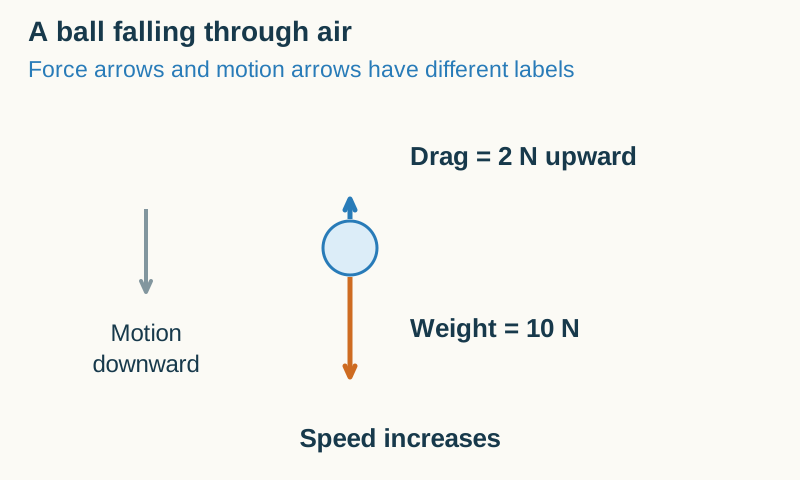
Weight is 10 N; drag is 2 N. The ball speeds up.

Next: Newton’s first law →
Practice, downloads and sources

Daily 5 · Exam practice · Revision sheet ↓

Foundation + Higher · P5. Twenty core lessons, followed by five labelled Higher Tier lessons.

AQA Combined Science Trilogy 8464 · 6.5.4.1.5. Original notes, questions and diagrams. Models are simplified; teaching data are illustrative.