sciencegcse← P5 overview

Physics · Paper 2 · Foundation + Higher · P5

Newton’s second law

Key ideas1 of 3

Resultant force causes acceleration

Newton’s second law links resultant force, mass and acceleration: F = m × a. F is resultant force in newtons (N), m is mass in kilograms (kg) and a is acceleration in m/s². Acceleration is in the direction of the resultant force. For the illustrated 2 kg object with a 6 N resultant force to the right, a = F ÷ m = 6 ÷ 2 = 3 m/s² to the right. Use the resultant force, after combining any opposing forces.
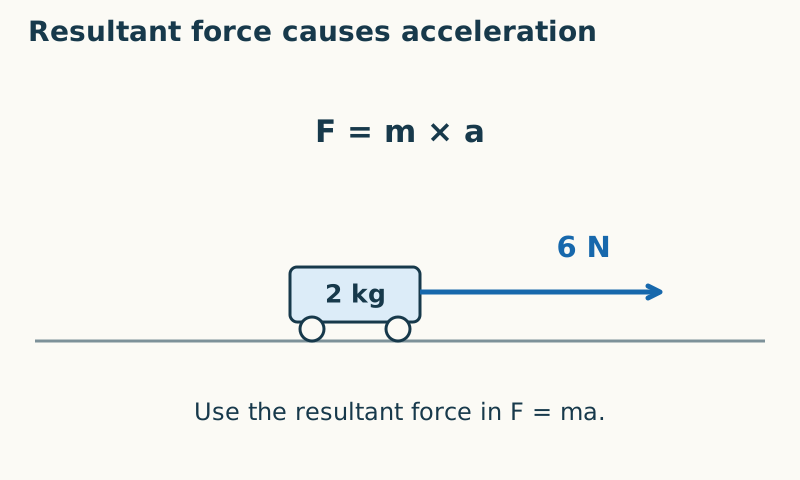
A 2 kilogram trolley experiences a resultant force of 6 newtons to the right.

Next: Required practical 19: force, mass and acceleration →
Practice, downloads and sources

Daily 5 · Exam practice · Revision sheet ↓

Foundation + Higher · P5. Twenty core lessons, followed by five labelled Higher Tier lessons.

AQA Combined Science Trilogy 8464 · 6.5.4.2.2. Original notes, questions and diagrams. Models are simplified; teaching data are illustrative.