A mixture contains two or more substances that are not chemically joined to each other. Each substance keeps its own properties.
We can separate mixtures using physical methods. Choose the method using properties such as solubility and boiling point.
Soluble: can dissolve in a solvent. Insoluble: cannot dissolve in that solvent. Salt dissolves in water; sand does not.
02 · Keep an insoluble solid
Filtration
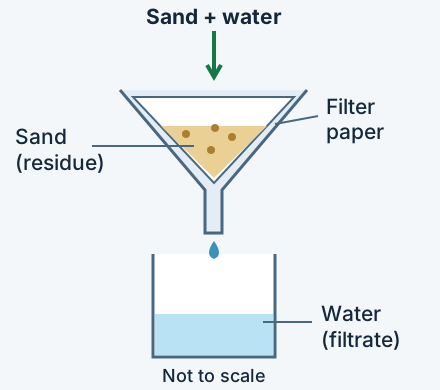
Use filtration to separate an insoluble solid from a liquid, such as sand from water.
Pour the mixture through filter paper. The sand stays on the paper as the residue. Water passes through as the filtrate.
Sand + water → filter → sand stays behind
Filter paper traps the insoluble sand.
Dissolved salt passes through filter paper. Filtration cannot separate salt from a salt solution.
03 · Recover a dissolved solid
Crystallisation
Use crystallisation to obtain a dissolved solid from a solution, such as salt from salt water.
Gently evaporate some solvent to concentrate the solution. Leave it to cool so crystals form. Filter and dry the crystals.
Salt solution → evaporate some water → cool → crystals
04 · Collect the solvent
Simple distillation
Use simple distillation to collect a solvent from a solution, such as pure water from salt water.
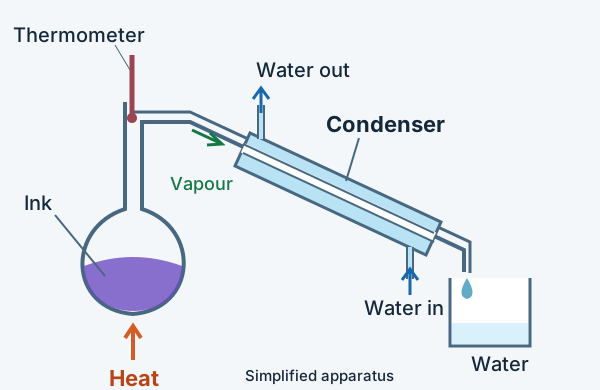
Heat the solution. Water evaporates, then the vapour cools in a condenser and becomes liquid water. The salt remains behind.
Water in solution → water vapour → liquid water
Example: distilling water-based ink
Water is collected; the non-volatile dyes stay in the flask.
1. Heat the ink to evaporate the water. 2. Cool the vapour in the condenser. 3. Collect colourless liquid water.
Cooling water enters the lower end of the condenser and leaves the upper end. It stays separate from the water being collected.
Evaporation changes liquid to gas. Condensation changes gas to liquid.
05 · Separate liquids
Fractional distillation
Use fractional distillation to separate a mixture of liquids with different boiling points, such as ethanol and water.
A fractionating column helps separate their vapours. The liquid with the lower boiling point is collected first.
Ethanol: 78°C · Water: 100°C Ethanol is collected first.
06 · Separate dissolved colours
Paper chromatography
Use chromatography to separate the soluble dyes in an ink.
Put a small ink spot on a pencil line. Keep the solvent level below the spot. As solvent moves up the paper, dyes travel different distances and separate.
Several spots from one ink show that the ink contains a mixture of dyes.
One ink separates into three dye spots.
07 · Measure the chromatogram
Calculating an Rf value
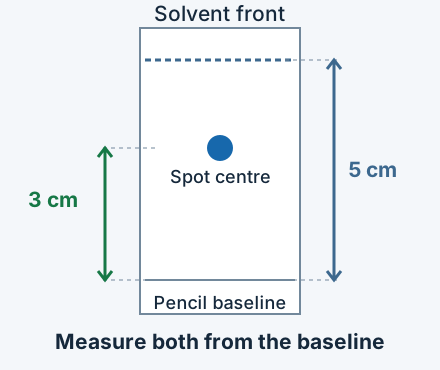
Rf compares how far a substance travels with how far the solvent travels.
Rf = distance travelled by substancedistance travelled by solvent
Measure to the centre of the spot and to the solvent front.
Rf = 3 cm5 cm = 0.60
Use the same units for both distances. An Rf value has no units and lies between 0 and 1.
Compare Rf values only when the same solvent and conditions are used.
Choose what you want to collect
Sand from water: filtration.
Salt from salt water: crystallisation.
Water from salt water: simple distillation.
Liquids with different boiling points: fractional distillation.
Dyes from ink: chromatography.
8 quick questions
Separation detective
★ 0 / 8
Choose the right method. Collect what you need.
Question 1 of 8Choose the method
Use the properties of the substances to separate them.
Choose a method
Which method?
★
Case closed!
One point for each answer you get right first time.
No timer. Take your time and use a clue whenever you need one.