sciencegcse← Topic extras

Separate Physics · Paper 2 · Higher Tier only · P5

Higher: force and rate of momentum change

Key ideas1 of 3

Connect force to momentum change

For constant mass, combine F = ma with a = Δv ÷ Δt to obtain F = mΔv ÷ Δt = Δp ÷ Δt. F is the mean resultant force in newtons, Δp is final minus initial momentum in kg m/s, and Δt is time in seconds. Keep a positive direction throughout. A shorter time for the same momentum change requires a larger mean force.
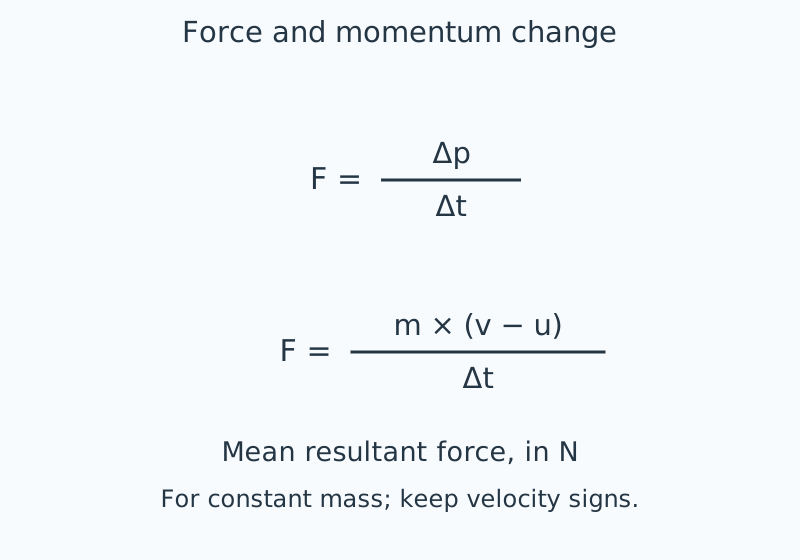
Mean resultant force equals momentum change divided by time, or mass times velocity change divided by time.

Try exam practice →
Practice, downloads and sources

Daily 5 · Exam practice · Revision sheet ↓

Higher Tier only · P5. Use alongside the shared P5 lessons.

AQA GCSE Physics 8463 · 4.5.7.3. Original notes, questions and diagrams. Models are simplified; teaching data are illustrative.