sciencegcse← Topic extras

Separate Physics · Paper 2 · Higher Tier only · P5

Higher: upthrust, floating and sinking

Key ideas1 of 3

Pressure difference gives upthrust

A submerged object has liquid above its top and bottom surfaces. The bottom is deeper, so pressure there is greater. Pressure forces act perpendicular to surfaces: downward on the top and upward on the bottom. For equal horizontal areas, the larger bottom force gives a resultant upward force called upthrust. Forces on opposite vertical sides cancel in a stationary liquid of uniform density.
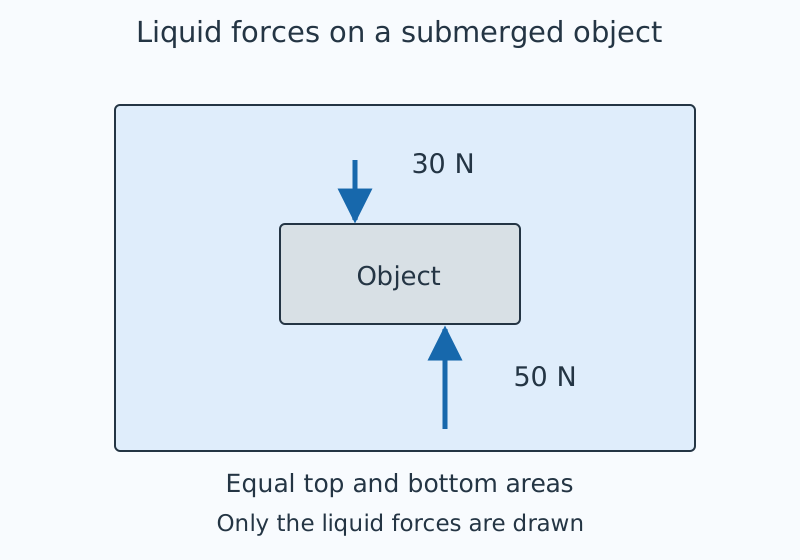
A submerged block with equal top and bottom areas has a 30 N downward top force and 50 N upward bottom force; weight is not drawn.

Next: Higher: calculations for collisions →
Practice, downloads and sources

Daily 5 · Exam practice · Revision sheet ↓

Higher Tier only · P5. Use alongside the shared P5 lessons.

AQA GCSE Physics 8463 · 4.5.5.1.2. Original notes, questions and diagrams. Models are simplified; teaching data are illustrative.