sciencegcse.co.uk← All lessons in this topic
Lesson 4.10 · AQA Combined Science

Electrolysis of solutions

Water adds extra ions

Aqueous means dissolved in water. Water supplies H⁺ and OH⁻ ions as well as the ions from the dissolved compound. Products can therefore differ from those of a molten compound. These GCSE rules use inert electrodes and a solution containing one ionic compound.
Choose each electrode separately

Cathode: if the metal is more reactive than hydrogen, hydrogen forms; otherwise the metal forms.
Anode: if halide ions (chloride, bromide, iodide) are present, the halogen forms; otherwise oxygen forms.

Try the common examples

Aqueous solutionCathode (−)Anode (+)
Sodium chlorideHydrogenChlorine
Copper chlorideCopperChlorine
Sodium sulfateHydrogenOxygen
Copper sulfateCopperOxygen

Always check molten or aqueous before choosing products. In molten sodium chloride the cathode product is sodium; in its aqueous solution it is hydrogen.

See the copper coating

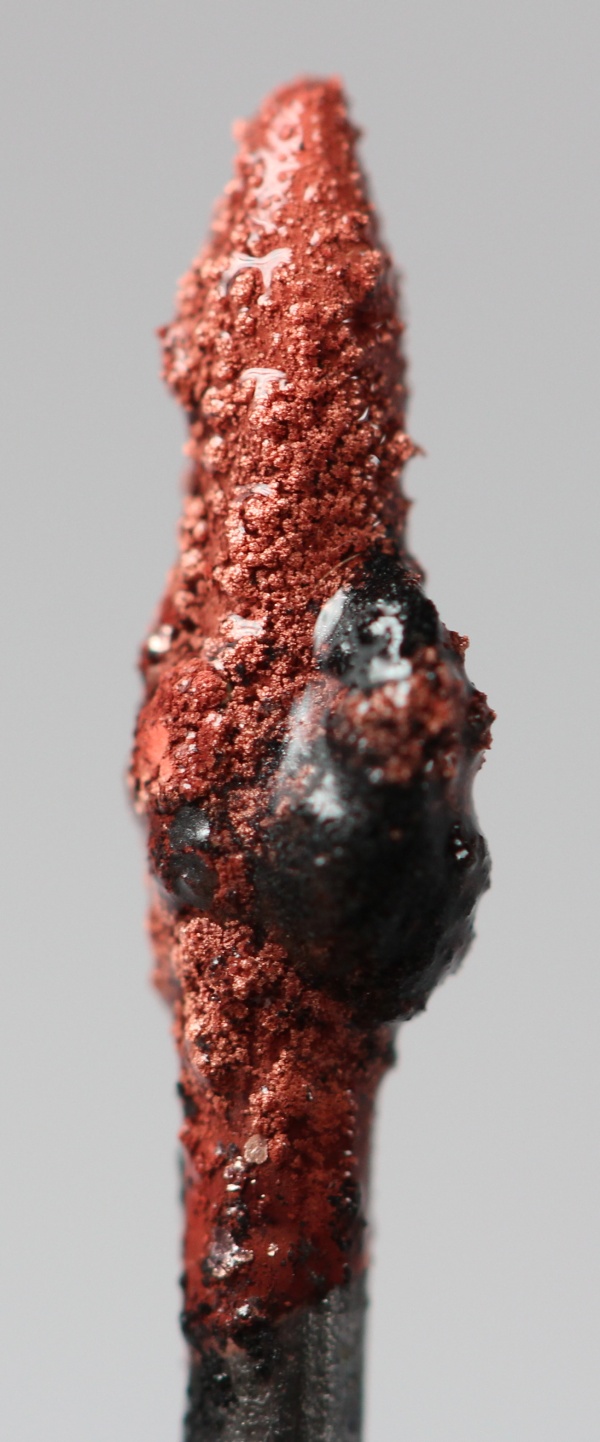
Reddish copper deposited on a black graphite electrode tip
Copper formed by electrolysis. The reddish metal coats the black graphite. Copper ions form copper metal at the cathode. View full photo ↗Photo: LuisBrudna · CC BY-SA 4.0 · Detail shown; full photo available above.

Remember

Aqueous cathode: metal or hydrogen. Anode: halogen if halide present, otherwise oxygen.