sciencegcse← Topic extras

Separate Biology · Paper 2 · Foundation + Higher · B7

RP10: investigating milk decay

Key ideas1 of 3

Model decay using an enzyme

Required practical 10 investigates temperature and milk decay through pH change. The suggested classroom model adds lipase to fresh milk made alkaline with sodium carbonate. Lipase breaks down milk fat, producing fatty acids that lower pH. This models an enzyme-controlled part of decay; it does not require growing unknown microorganisms. Natural microbial souring produces lactic acid, but the lipase model tests enzyme activity rather than microbial population growth.
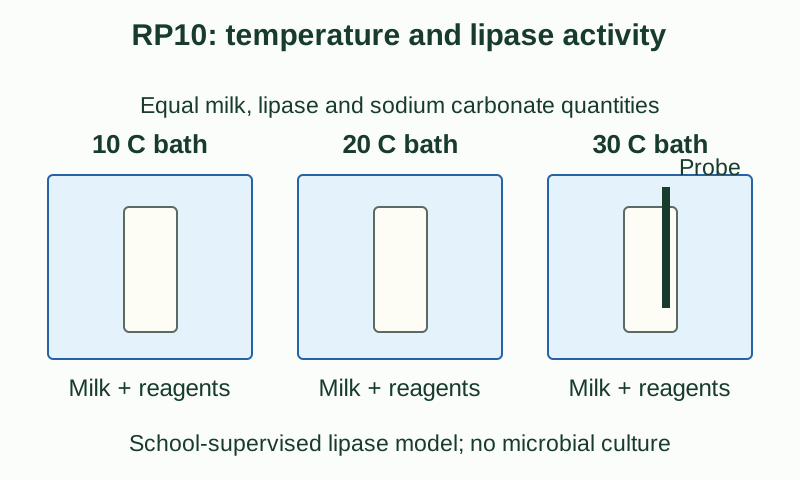
Three water baths at 10, 20 and 30 C hold matching tubes with equal quantities of milk, lipase and sodium carbonate. A pH probe is shown in one tube. School-supervised enzyme model, not a microbial culture.

Next: RP10: interpreting decay data →
Practice, downloads and sources

Daily 5 · Exam practice · Revision sheet ↓

Foundation + Higher · B7. Use alongside the shared B7 lessons.

AQA GCSE Biology 8461 · 4.7.2.3 / RP10. Original notes, questions and diagrams. Models are simplified; teaching data are illustrative.