sciencegcse← Topic extras

Separate Physics · Paper 1 · Foundation + Higher · P3

Gas pressure and volume at constant temperature

Key ideas1 of 3

Collisions produce pressure

Gas particles move randomly in all directions and collide with the walls of their container. Each collision changes a particle’s momentum and produces a force on the wall. The resulting gas pressure acts normally to the surface: at right angles to it. A gas can be compressed because its particles are widely spaced, allowing the distances between particles to become smaller without shrinking the particles themselves.
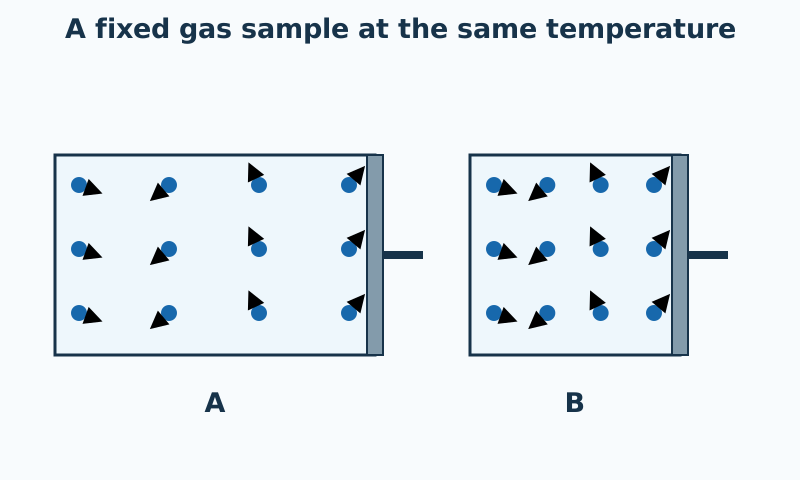
Two piston containers labelled A and B with the same number of particle symbols and motion arrows.

Next: Using and testing the pressure–volume equation →
Practice, downloads and sources

Daily 5 · Exam practice · Revision sheet ↓

Foundation + Higher · P3. Use alongside the shared P3 lessons.

AQA GCSE Physics 8463 · 4.3.3.2. Original notes, questions and diagrams. Models are simplified; teaching data are illustrative.